Small Kitchen Countertop Organization Ideas to Free Up Prep Space
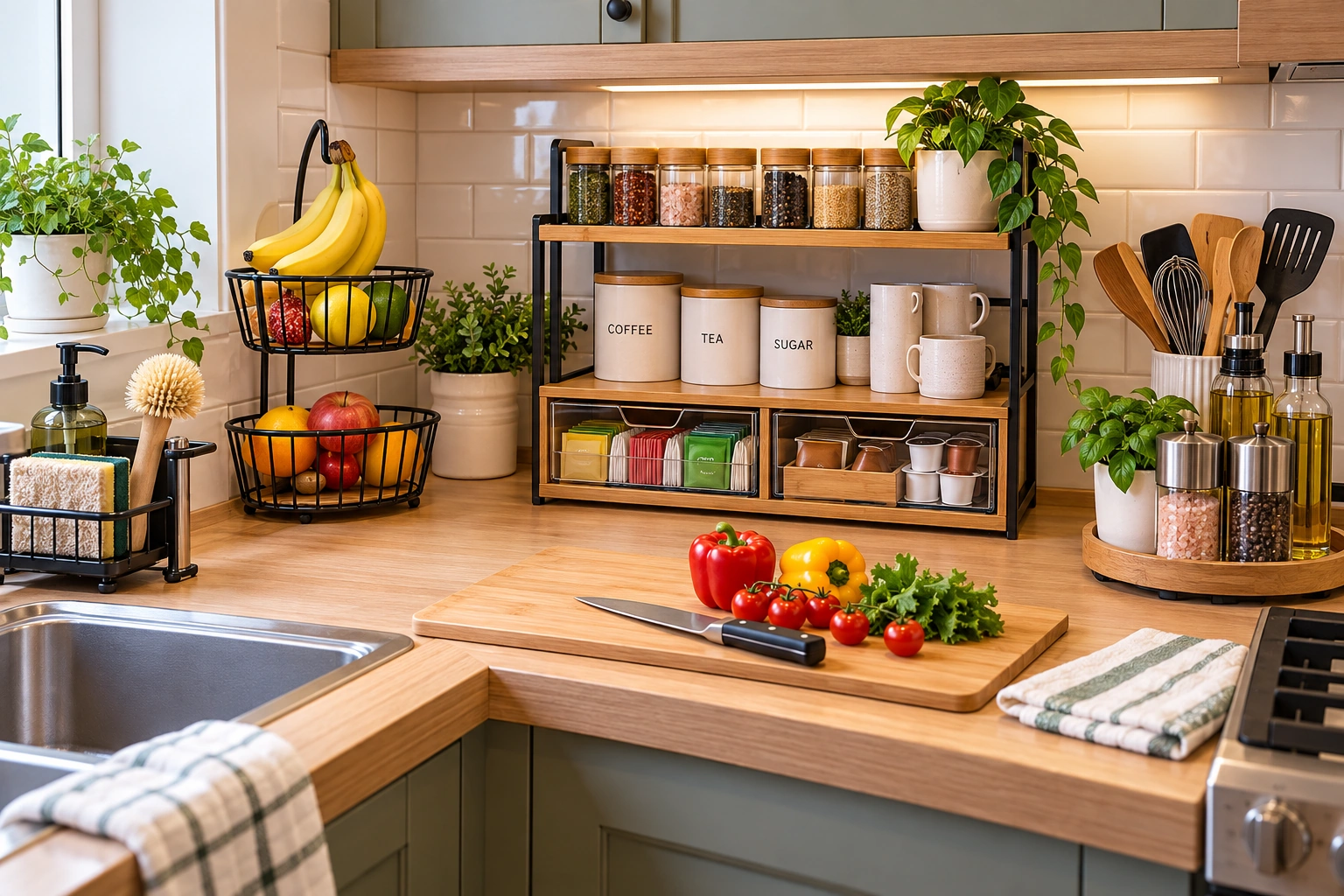
Small kitchen countertop organization ideas work best when they reduce the number of items sitting directly on the counter and move frequently used essentials into vertical, corner, wall-mounted, or grouped storage. The goal is not to make the kitchen look empty. It is to protect enough clear countertop space for chopping, mixing, plating, and everyday meal prep.
In a small kitchen, even a few appliances, bottles, fruit bowls, utensils, and cleaning supplies can consume most of the available work surface.
A practical system is:
clear the prep zone + group daily-use items + use vertical space + use corners + move sink clutter off the counter + store rarely used items elsewhere
You do not need a large kitchen to create usable prep space. A few targeted changes can make a narrow counter feel significantly more functional.
As an Amazon Associate, PickaVault earns from qualifying purchases.
Why Do Small Kitchen Counters Get Cluttered So Quickly?
Small countertops usually have to perform several jobs at once.
They may need to hold:
- Coffee equipment
- Cooking oils
- Utensils
- Fruit
- Paper towels
- Spices
- Dish soap
- Sponges
- Appliances
- Cutting boards
- Food during meal prep
The problem is not always that you own too much.
Often, too many categories are competing for the same horizontal surface.
That is why the most effective small kitchen countertop organization ideas focus on changing where items live rather than simply placing them into decorative containers.
1. Start by Creating One Clear Prep Zone
Before buying organizers, choose the part of your counter that you want to keep mostly clear.
Ideally, this should be close to:
- The sink
- The stove
- A drawer containing knives and utensils
You do not need the entire countertop to be empty.
You need one reliable work area where you can:
- Chop vegetables
- Mix ingredients
- Plate food
- Set down groceries
- Prepare lunch
Treat this area as protected space.
Avoid allowing mail, decorative accessories, appliance cords, or backup supplies to slowly migrate back into it.
2. Remove Everything You Do Not Use Regularly
Take everything off the countertop and ask how often you actually use it.
Items used daily may deserve countertop space.
Items used weekly can often move into:
- Cabinets
- Pantry shelves
- Drawers
- Upper shelves
Items used only occasionally should almost never occupy prime counter space in a small kitchen.
Examples might include:
- Stand mixer attachments
- Specialty appliances
- Large serving bowls
- Extra cutting boards
- Baking equipment
One of the simplest small kitchen countertop organization ideas is simply reducing the number of items that permanently live there.
3. Group Everyday Items Into Stations
A small kitchen becomes easier to use when related objects stay together.
Possible stations include:
Coffee Station
Keep together:
- Coffee maker
- Coffee
- Filters
- Mugs
- Sweeteners
Cooking Station
Group:
- Cooking oil
- Salt
- Pepper
- Frequently used seasonings
Sink Station
Keep:
- Dish soap
- Sponge
- Brush
together instead of spreading them across the sink edge and counter.
Grouping creates visual order and reduces unnecessary movement while you cook.
4. Use a Kitchen Counter Organizer Shelf to Go Vertical
One of the most practical small kitchen countertop organization ideas is to use vertical space instead of spreading items across the work surface. Horizontal space is limited in a small kitchen, but vertical space is often unused.
A kitchen counter organizer shelf creates an additional level above the countertop.
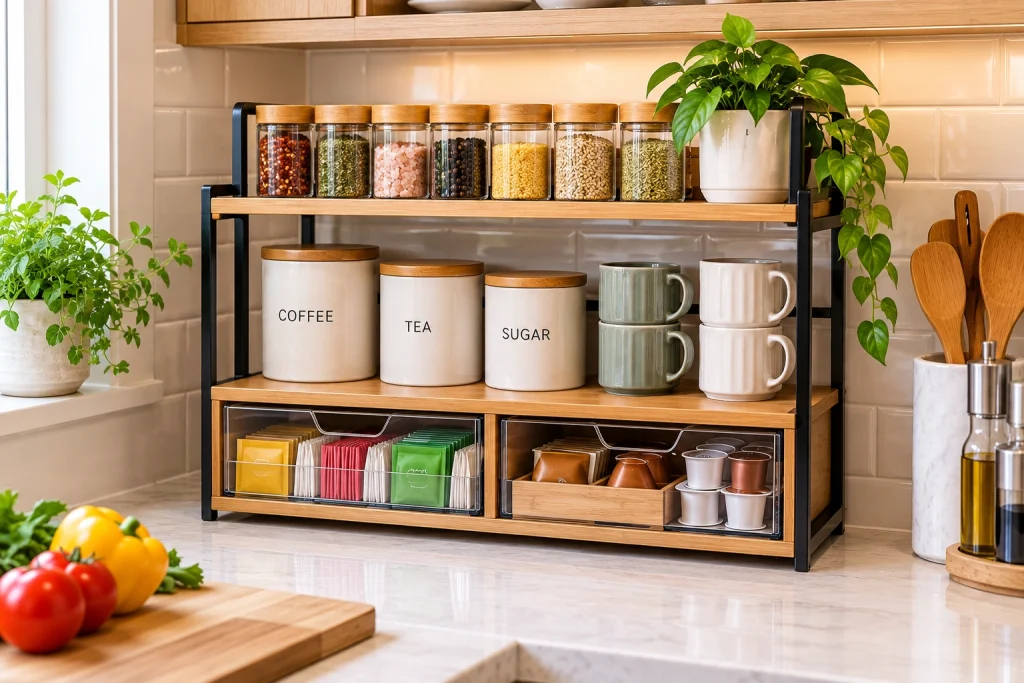
It can hold:
- Spices
- Mugs
- Small containers
- Tea
- Coffee supplies
- Oils
- Everyday dishes
Corner versions are especially helpful because corners often become dead space.
For example, see this 3-tier corner kitchen countertop organizer shelf on Amazon. The linked product is designed as a three-tier corner shelf for countertop organization.
Place the least-used items on the upper tier and daily-use items where they are easiest to reach.
5. Use the Corner Instead of Ignoring It
Kitchen corners frequently collect random objects because they are awkward to use for food preparation.
That makes them useful for organized storage.
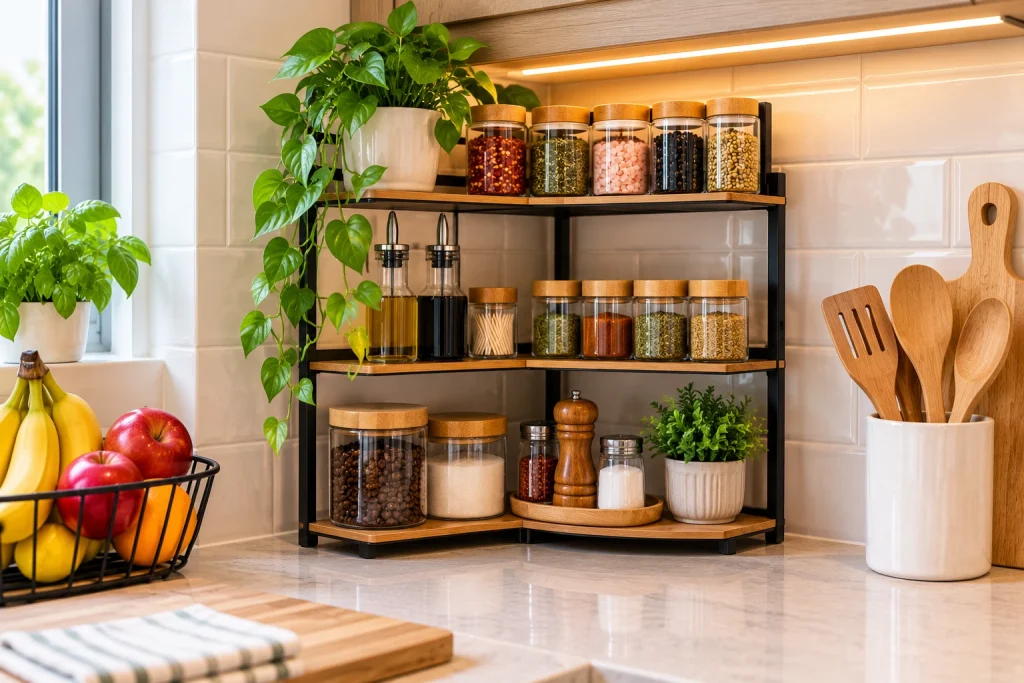
A corner can hold:
- Tiered shelving
- Coffee supplies
- Spice jars
- Small plants
- Mugs
- Canisters
The important part is keeping the organizer within the natural footprint of the corner.
If a shelf projects too far forward, it may take away more prep space than it saves.
Measure before buying.
6. Use a Lazy Susan for Oils, Condiments, and Spices
Bottles lined against the backsplash often become difficult to access. The bottle at the back usually requires moving everything in front of it.
A turntable solves that problem.
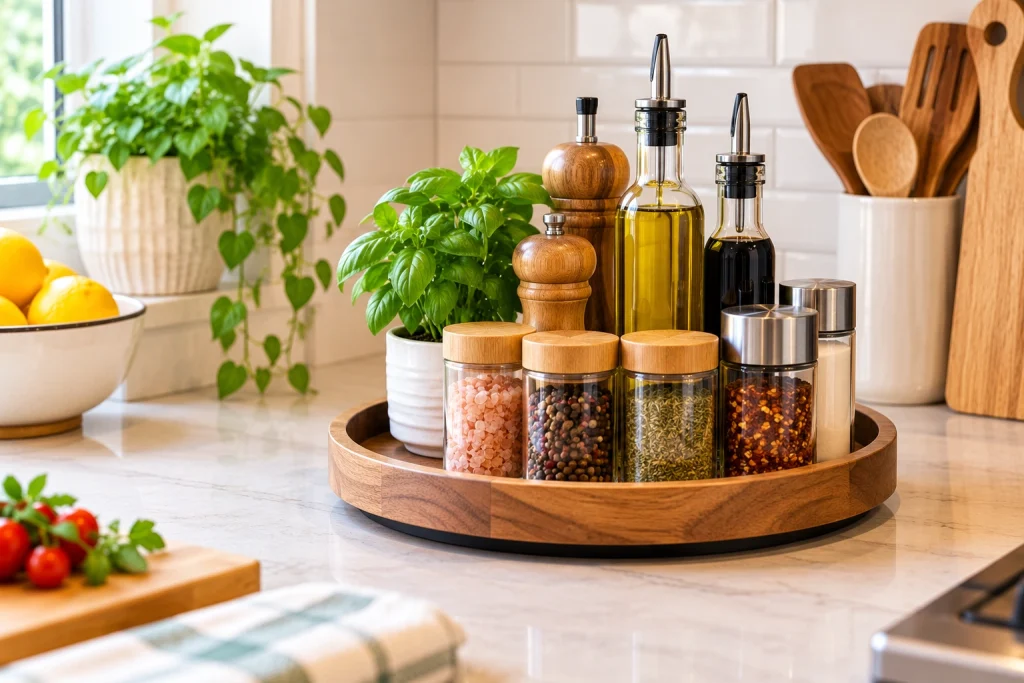
Use one for:
- Olive oil
- Vinegar
- Salt
- Pepper
- Frequently used sauces
- Small spice jars
A wooden turntable can also make a practical group of bottles look more intentional.
See this farmhouse-style wooden Lazy Susan on Amazon. The linked item is a 9-inch rotating organizer intended for cabinets or countertops.
Keep the number of bottles limited.
A rotating tray packed with twenty products still creates visual clutter.
7. Move Sponge and Brush Clutter Off the Counter
Wet sponges, scrubbers, and dish brushes can take up surprising amounts of countertop space near the sink.
Instead of keeping everything beside the faucet, use a dedicated sink organizer.
A compact holder can keep:
- Sponge
- Dish brush
- Scrubber
- Soap
together.
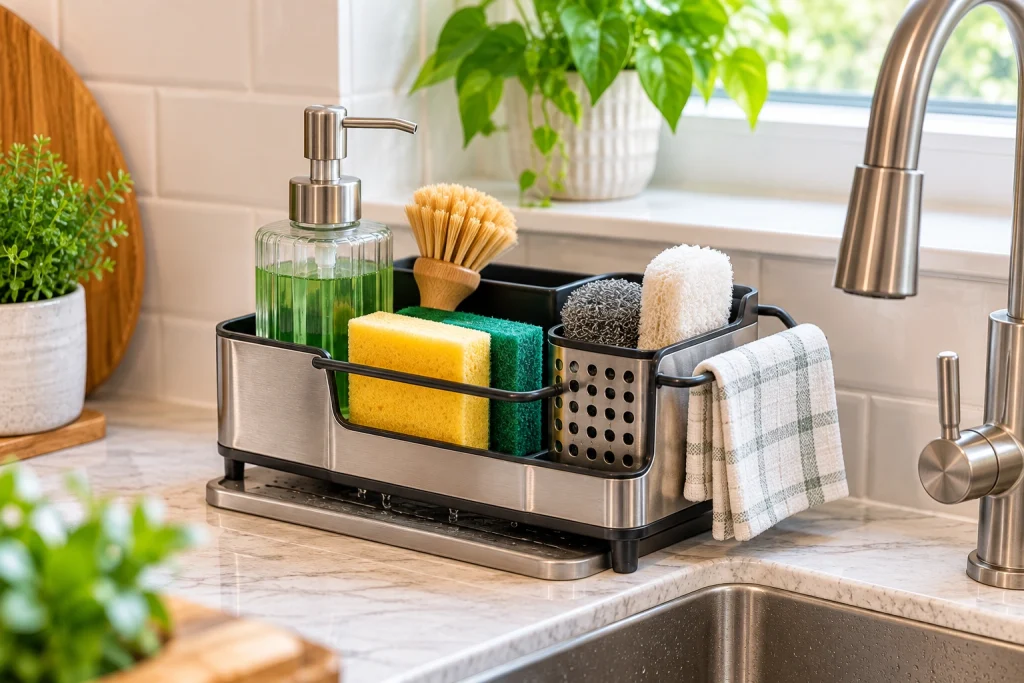
See this kitchen sink organizer with a brush holder on Amazon. The linked product is designed specifically for organizing sink-side sponges and brushes.
The goal is to contain the entire sink-cleaning category within one small footprint.
8. Consider Mounting the Sponge Holder Inside the Sink Area
If your countertop is extremely limited, even a sink caddy may take up more space than you want.
A wall- or sink-mounted holder can move scrubbers off the countertop entirely.
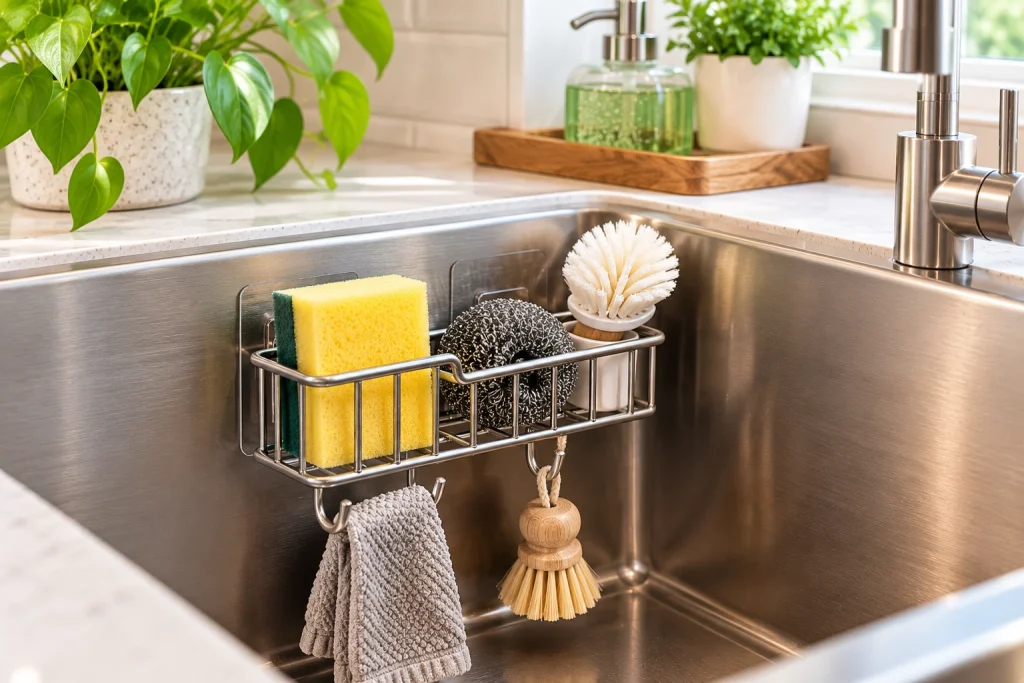
See this adhesive-mounted stainless-steel sponge holder on Amazon. The product is designed to hold sponges and scrubbers while mounting to a suitable smooth surface.
This is particularly useful in very small kitchens where the strip of countertop beside the sink needs to remain free.
Follow the manufacturer’s installation requirements for the mounting surface.
9. Store Fruit Vertically Instead of in a Wide Bowl
A traditional fruit bowl can consume a large circle of countertop space.
Vertical baskets use height instead.
A two-tier produce basket can separate:
top: lighter fruits
bottom: larger produce
Some designs also provide hooks for bananas.
See this two-tier fruit basket with banana hangers on Amazon. The linked product uses stacked metal baskets to increase produce storage vertically.
Do not overfill the baskets.
The purpose is to consolidate produce, not create a tower that is difficult to use.
10. Use the Space Above the Microwave
A countertop microwave can take up a large amount of horizontal space.
If you cannot relocate it, use the vertical space above it.
An expandable microwave shelf can create storage for:
- Plates
- Bowls
- Containers
- Small appliances
- Kitchen towels
See this expandable microwave countertop shelf on Amazon. The linked rack is designed to create an additional storage level over a countertop microwave.
Before using any over-microwave rack, check your appliance manufacturer’s ventilation and clearance requirements.
Never block ventilation openings.
11. Store Pans Vertically Instead of Stacking Them
Pans do not always need to live on the countertop, but poorly organized cookware can indirectly create counter clutter.
When cabinets are difficult to use, pots and lids often end up sitting out.
A vertical cookware organizer can make cabinet storage easier.
See this adjustable pots, pans, lids, and bakeware organizer on Amazon. The linked rack includes adjustable compartments for separating cookware.
Keeping cookware easy to retrieve makes it more likely that you will put it back instead of leaving it on the counter.
12. Use a Kitchen Countertop Organizer With Drawers for Small Items
A kitchen countertop organizer with drawers can be useful when your counter collects small loose items such as:
- Tea bags
- Coffee pods
- Measuring spoons
- Clips
- Sweetener packets
- Small tools
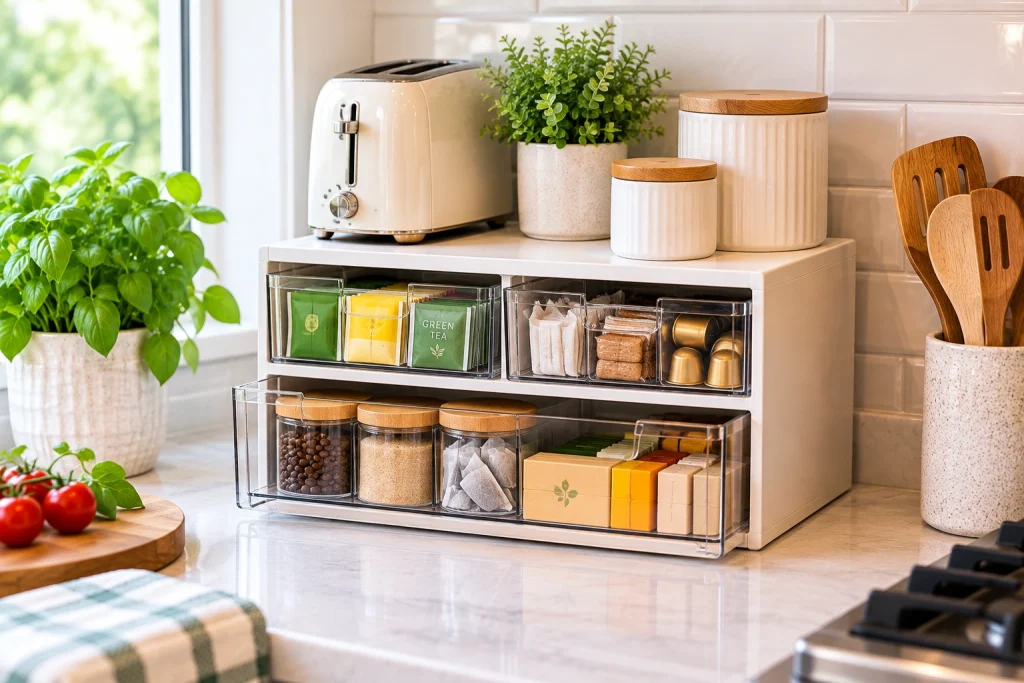
The important thing is to use drawers for a defined category.
Do not create a countertop junk drawer.
A compact organizer should replace visible clutter, not simply give the clutter another place to accumulate.
If you already have enough drawer storage below the counter, use that first.
Countertop drawers are most useful when cabinet and drawer storage are genuinely limited.
13. Keep Frequently Used Utensils Together
Cooking utensils are reasonable countertop items if you use them daily.
Instead of letting them spread across several containers, use one utensil holder.
Keep only your most-used tools there, such as:
- Wooden spoon
- Spatula
- Tongs
- Ladle
- Whisk
Move duplicates and specialty tools into a drawer.
A utensil crock containing fifteen tools often becomes harder to use than a drawer.
14. Store Cutting Boards Vertically
Simple trays are one of the easiest small kitchen countertop organization ideas because they keep related items contained within a defined area. Cutting boards laid flat consume valuable prep space.
Stand them vertically against a backsplash or inside a narrow rack.
This works particularly well for:
- Cutting boards
- Baking sheets
- Serving boards
- Cooling racks
Keep only one or two frequently used cutting boards on the counter.
The rest can go inside a cabinet.
Vertical storage uses a much smaller footprint.
15. Use Trays to Create Visual Boundaries
A tray can turn several loose items into one visual group.
For example:
oil + salt + pepper
or:
coffee + sugar + spoons
or:
soap + hand lotion
The tray creates a boundary.
If something does not fit comfortably on the tray, consider storing it elsewhere.
This prevents stations from gradually spreading across the counter.
16. Keep Appliances Based on How Often You Use Them
Small kitchens often become appliance storage rooms.
Ask how often each appliance is actually used.
Daily
May deserve counter space:
- Coffee maker
- Kettle
- Toaster
Several Times a Week
Depends on available space:
- Blender
- Air fryer
Occasionally
Usually better stored:
- Food processor
- Stand mixer
- Slow cooker
- Specialty appliances
You do not need to follow someone else’s idea of which appliances should stay visible.
Your own routine matters more.
17. Use the Backsplash Area Without Overcrowding It
The space immediately against the backsplash is useful because it is usually outside the main cutting area.
Use the back edge of the counter for shallow items such as:
- Knife block
- Narrow spice shelf
- Utensil holder
- Small tray
Avoid placing deep organizers there.
You still want enough space in front of them to work comfortably.
18. Keep Paper Towels From Taking Over the Counter
A paper-towel roll occupies more counter space than it seems.
If your kitchen is extremely small, consider:
- Under-cabinet holder
- Wall-mounted holder
- Cabinet-door holder
If you prefer keeping the roll on the counter, place it in a corner rather than the center of your prep area.
Small changes like this can add up quickly.
19. Move Decorative Items Away From Prime Prep Space
Plants, candles, decorative boards, and bowls can make a kitchen feel welcoming.
But in a small kitchen, functional space should come first.
Keep decor:
- On upper shelves
- On windowsills
- In unused corners
- On top of cabinets where appropriate
Avoid placing decorations directly in the primary prep zone.
One intentional decorative item usually looks better than several small objects scattered across the counter.
20. Keep Frequently Used Ingredients Close to the Stove
If you use certain ingredients almost every time you cook, keeping them nearby can make sense.
Examples include:
- Olive oil
- Salt
- Pepper
Group them on one small tray or turntable.
Everything else can stay in the pantry or spice cabinet.
The phrase frequently used matters.
Do not bring the entire pantry onto the counter for convenience.
21. Give the Coffee Station a Fixed Footprint
Coffee equipment can easily expand into a large countertop category.
Define a specific area for it.
For example:
coffee machine + small tray + mug shelf
Keep backup coffee, extra mugs, and unopened supplies in cabinets.
A vertical kitchen counter organizer shelf above or beside the coffee machine can help if cabinet storage is limited.
The station should remain within its assigned boundary.
22. Keep the Sink Area as Dry as Possible
Wet cloths, sponges, and brushes create visual clutter and can keep the counter damp.
Give each item a drying location.
For example:
- Sponge holder
- Brush caddy
- Towel rail
- Sink-mounted organizer
Keep dish soap in one consistent location.
Once the sink area has a clear system, the entire countertop usually looks more organized.
23. Protect Your Main Food-Preparation Surface
Countertop organization is not only about appearance.
A clear prep surface is easier to clean before and after food preparation.
The USDA recommends washing countertops and other food-contact surfaces as part of safe food handling and emphasizes cleaning surfaces before moving between food-preparation tasks. (Food Safety and Inspection Service)
For more guidance, see the USDA’s food-safety advice on cleaning kitchen surfaces.
Keep this authority link:
Nofollow OFF
Sponsored OFF
Open in new tab ON
24. Avoid Filling Every Inch With Organizers
One common mistake is replacing countertop clutter with organizer clutter.
A three-tier shelf, turntable, utensil holder, fruit basket, drawer organizer, coffee rack, and decorative tray may each be useful individually.
Together, they can consume the entire counter.
Every organizer should solve a specific problem.
Before adding one, ask:
What items will this remove from the counter?
If the answer is unclear, you probably do not need it.
25. Use One-In, One-Out Rules for Countertop Items
Countertop storage should have a limit.
If you add a new appliance or organizer, decide whether something else should move.
For example:
new air fryer → toaster moves into cabinet
or:
new fruit basket → old fruit bowl is removed
This prevents gradual countertop expansion.
Small Kitchen Countertop Organization Ideas for Renters
Renters may not want to drill holes into cabinets or backsplashes.
Focus on removable solutions such as:
- Freestanding shelves
- Lazy Susans
- Trays
- Tiered baskets
- Tension-based solutions
- Adhesive products designed for suitable surfaces
Always check removal instructions before using adhesives.
Freestanding organizers are often the safest option when you want to avoid permanent changes.
Small Kitchen Countertop Organization Ideas on a Budget
You do not need to buy an entire matching organizer collection.
Start by removing unnecessary objects.
Then use items you already own:
- Trays
- Baskets
- Jars
- Small shelves
- Bowls
Spend money only where a product solves a genuine storage problem.
A good priority order is:
- Clear the prep zone.
- Move sink clutter.
- Use vertical storage.
- Organize corners.
- Consolidate bottles and ingredients.
- Deal with large appliances.
Decluttering costs nothing and often produces the biggest improvement.
How to Organize a Countertop in a Very Small Kitchen
When countertop space is extremely limited, choose only a few permanent items.
A simple setup might be:
Near the Stove
oil + salt + pepper
Near the Sink
soap + compact sponge holder
One Corner
vertical fruit basket or countertop shelf
Main Counter
clear prep zone
Everything else stays in cabinets or drawers.
The best small kitchen countertop organization ideas create usable empty space rather than filling every gap with storage.
A Simple Small-Kitchen Countertop Formula
If you want an easy system, use this:
Prep Zone
mostly empty
Back Edge
one narrow utensil or seasoning station
Corner
vertical organizer
Sink
compact sponge and soap storage
Produce
vertical basket
Appliances
daily-use only
Cabinets
backup supplies + occasional appliances
That is often enough.
What Should Stay on a Small Kitchen Counter?
Keep items on the counter when they are:
- Used frequently
- Difficult to store elsewhere
- Helpful during everyday cooking
Good candidates may include:
- Coffee maker
- Kettle
- Utensil holder
- Cutting board
- Cooking oil
- Fruit basket
The exact list depends on your routine.
If an item is used once a month, it probably does not deserve permanent countertop space.
What Should Be Removed From a Small Kitchen Counter?
Consider removing:
- Duplicate appliances
- Backup ingredients
- Extra mugs
- Medicine
- Random paperwork
- Large decorative pieces
- Specialty cooking tools
- Unused containers
These items can slowly turn a work surface into general household storage.
Your kitchen counter should primarily support kitchen tasks.
Common Small Kitchen Countertop Organization Mistakes
Buying Organizers Before Decluttering
Remove unnecessary items first.
Using Too Many Small Containers
Lots of little containers can create more visual clutter.
Keeping Every Appliance Out
Daily-use appliances deserve priority.
Ignoring Corners
Corners are valuable for vertical storage.
Storing Wet Sponges on the Counter
Use a dedicated drying holder.
Covering the Entire Backsplash With Storage
Leave room for food preparation.
Forgetting About Vertical Space
A shelf can provide more storage without consuming much additional counter area.
Frequently Asked Questions About Small Kitchen Countertop Organization
How do I organize a small kitchen countertop?
Organize a small kitchen countertop by creating one clear prep zone, removing rarely used items, grouping daily essentials into stations, and using vertical or corner storage for items that need to remain accessible.
Keep frequently used items closest to where they are used.
How can I get more counter space in a small kitchen?
Move rarely used appliances into cabinets, use vertical shelves, consolidate sink supplies, store produce vertically, and use walls or corners where appropriate.
The goal is to remove items from the main working surface.
What should I keep on my kitchen counter?
Keep only items you use regularly.
This may include a coffee maker, utensil holder, cooking oil, fruit, or kettle depending on your routine.
Are countertop organizers worth it?
Yes, when they reduce the amount of countertop area occupied by loose items.
They are less useful when they simply add another object without consolidating anything.
Is a kitchen counter organizer shelf useful in a small kitchen?
Yes. A kitchen counter organizer shelf can use vertical space for spices, mugs, coffee supplies, containers, or other frequently used items while preserving more horizontal counter space.
Is a kitchen countertop organizer with drawers useful?
A kitchen countertop organizer with drawers can be useful for small items such as tea bags, coffee pods, clips, measuring spoons, or packets when drawer space elsewhere is limited.
Choose a compact model so the organizer does not consume more counter space than it saves.
How do I organize the area around my kitchen sink?
Keep dish soap, sponge, brush, and scrubber together in a compact caddy or sink-mounted organizer.
Move backup supplies under the sink.
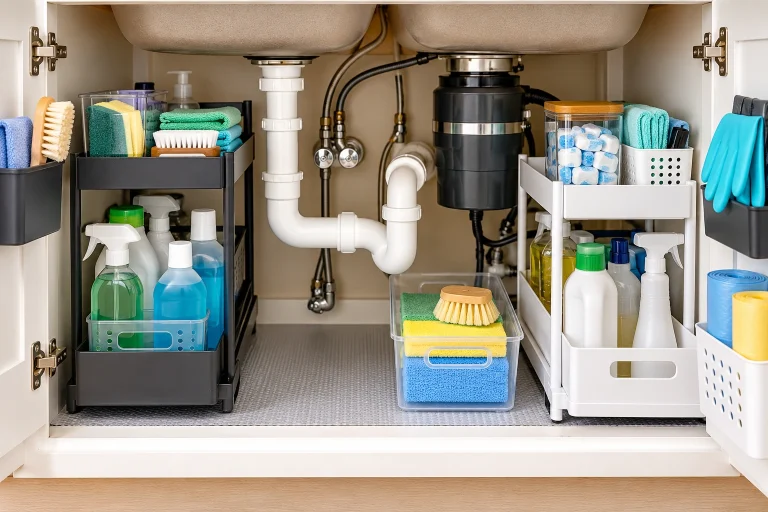
For more ideas on using the cabinet below, see How to Organize Under the Kitchen Sink Around Pipes and Tight Spaces.
How do I make a small kitchen counter look less cluttered?
Reduce the number of visible objects, consolidate related items onto trays, use similar storage materials, and leave one substantial section of counter completely clear.
Visible empty space makes the kitchen feel calmer.
Final Thoughts
The best small kitchen countertop organization ideas do not try to squeeze an organizer into every available inch.
They create more room to actually use the kitchen.
Start by protecting one clear prep zone.
Remove appliances and supplies you do not use regularly.
Move upward with a kitchen counter organizer shelf when vertical storage makes sense.
Use corners instead of letting them become clutter zones.
Move sponges and brushes away from the main countertop.
Use stacked produce storage, turntables, trays, and compact organizers only where they solve a real problem.
And if small loose items still need a home, a kitchen countertop organizer with drawers can help—as long as it replaces clutter rather than adding another bulky object.
The final test is simple:
Can you walk into the kitchen and immediately find enough clear space to prepare food?
If the answer is yes, your countertop organization system is doing its job.