How to Organize Under the Kitchen Sink Around Pipes and Tight Spaces
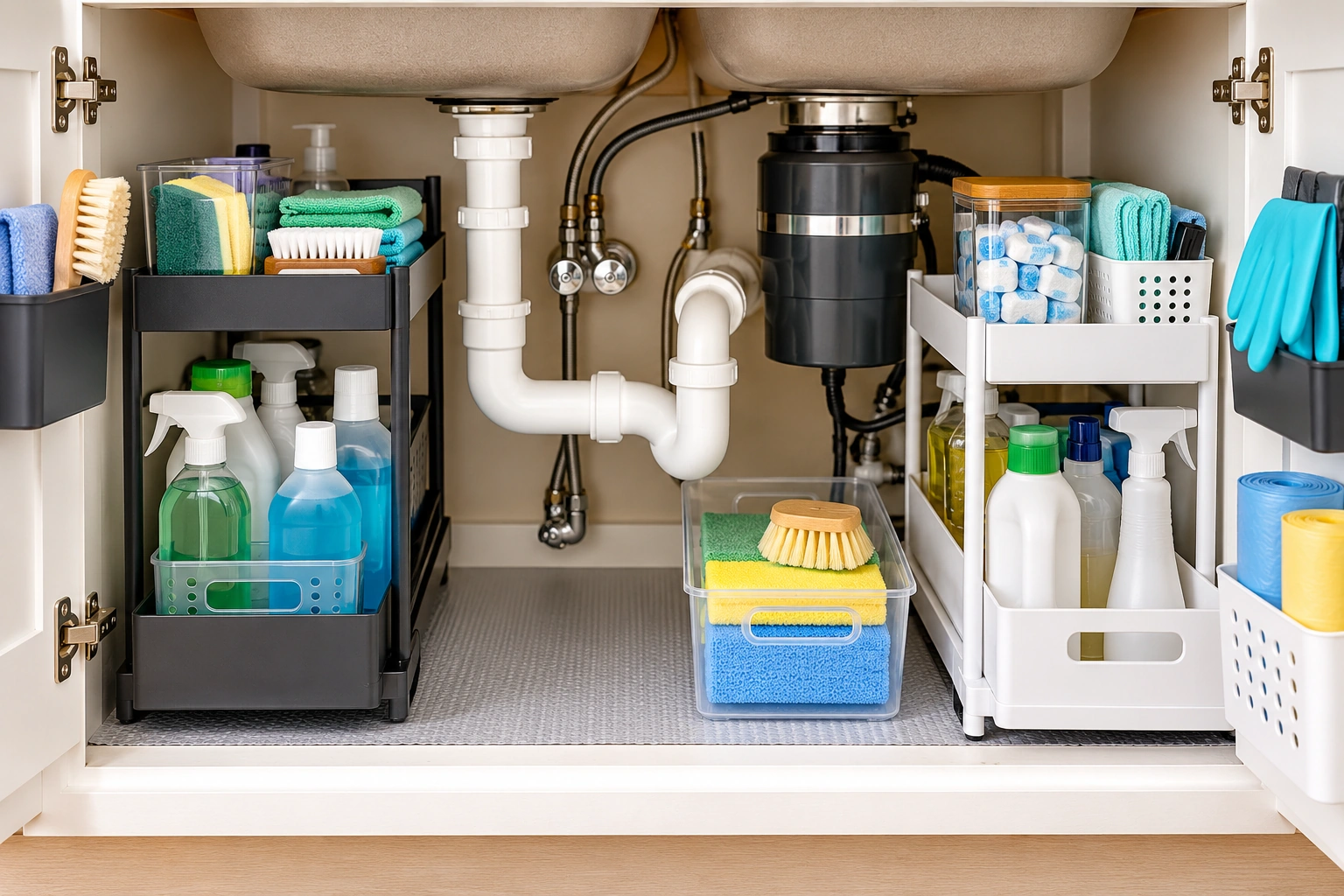
Under kitchen sink organization ideas work best when they are designed around the plumbing instead of trying to hide it. The most effective setup leaves room for pipes, the garbage disposal, shutoff valves, and the P-trap while using the remaining space for pull-out storage, vertical organizers, cleaning supplies, and leak protection.
The area under a kitchen sink is one of the hardest cabinets to organize because almost none of the available space is perfectly rectangular. Pipes cut through the middle, the disposal may occupy one side, bottles are different heights, and leaks can damage both the cabinet and anything stored inside.
The solution is not to fill every inch.
A good kitchen under sink organization system should make frequently used items easy to reach while keeping plumbing visible and accessible.
A practical formula is:
protect the cabinet floor + work around the pipes + use vertical space + group supplies by purpose + keep plumbing accessible
As an Amazon Associate, PickaVault earns from qualifying purchases.
Why Is the Space Under the Kitchen Sink So Difficult to Organize?
Under-sink cabinets look spacious when empty, but much of that space is interrupted by plumbing.
You may need to work around:
- Drain pipes
- P-trap
- Water supply lines
- Shutoff valves
- Garbage disposal
- Dishwasher connections
- Sink basin depth
That is why standard rectangular bins do not always work well.
The most successful under kitchen sink organization ideas treat these obstacles as fixed boundaries and build storage around them.
Instead of asking, “How many bins can I fit under here?” ask: “Which parts of this cabinet can actually be used without blocking the plumbing?”
That small change in thinking makes the entire project easier.
1. Empty the Cabinet Completely Before Organizing
Do not try to reorganize the cabinet while everything is still inside. Remove every item first. Group what you find into categories such as:
- Dishwashing supplies
- Surface cleaners
- Sponges
- Dishwasher tablets
- Trash bags
- Gloves
- Scrub brushes
- Extra soap
- Cleaning cloths
- Specialty cleaners
Then discard empty bottles, dried-out products, damaged sponges, and anything you no longer use.
You may discover that a large part of the clutter is simply duplicate or forgotten products. Wipe the cabinet floor and walls before putting anything back. This is also the best time to inspect the plumbing for moisture.
2. Check for Leaks Before Adding Organizers
Organization should come after leak inspection.
Look around:
- Pipe joints
- P-trap connections
- Supply lines
- Shutoff valves
- Garbage disposal
- Cabinet corners
Check for:
- Water droplets
- Damp wood
- Discoloration
- Swelling
- Musty odors
Do not cover a suspected leak with storage containers.
Fix the plumbing issue first. A beautifully organized cabinet is not useful if water is slowly damaging the cabinet underneath it.
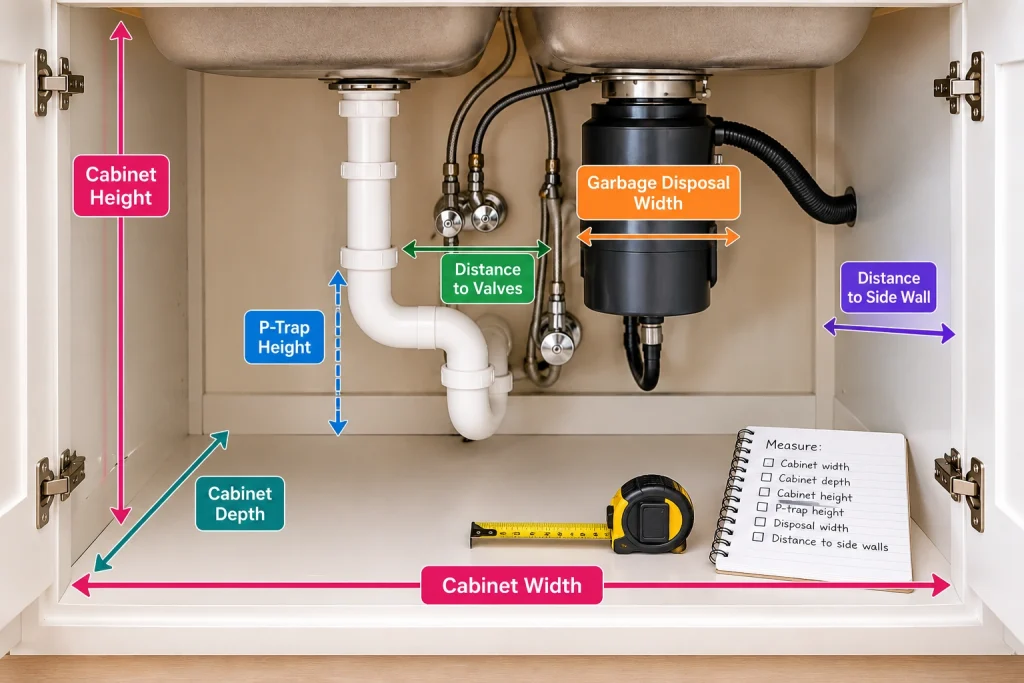
3. Measure Around the Plumbing — Not Just the Cabinet
One of the biggest mistakes when trying to organize under sink kitchen storage is measuring only the cabinet width and depth. Many under kitchen sink organization ideas fail simply because the plumbing was not measured before buying storage.
You also need to measure the obstacles inside it.
Record:
- Interior cabinet width
- Interior depth
- Usable height
- Height of the P-trap
- Distance from the pipes to each side wall
- Garbage-disposal width
- Clearance around shutoff valves
Measure the cabinet opening as well.
An organizer might technically fit inside the cabinet but still be too wide to pass through the door opening.
A few minutes with a tape measure can prevent buying storage that does not fit.
4. Protect the Cabinet Floor First
Before adding baskets or organizers, protect the cabinet base.
The area under a kitchen sink is one of the most likely cabinet spaces to encounter drips or small leaks.
A waterproof mat or removable liner creates a barrier between stored products and the cabinet floor. It also makes cleaning easier.
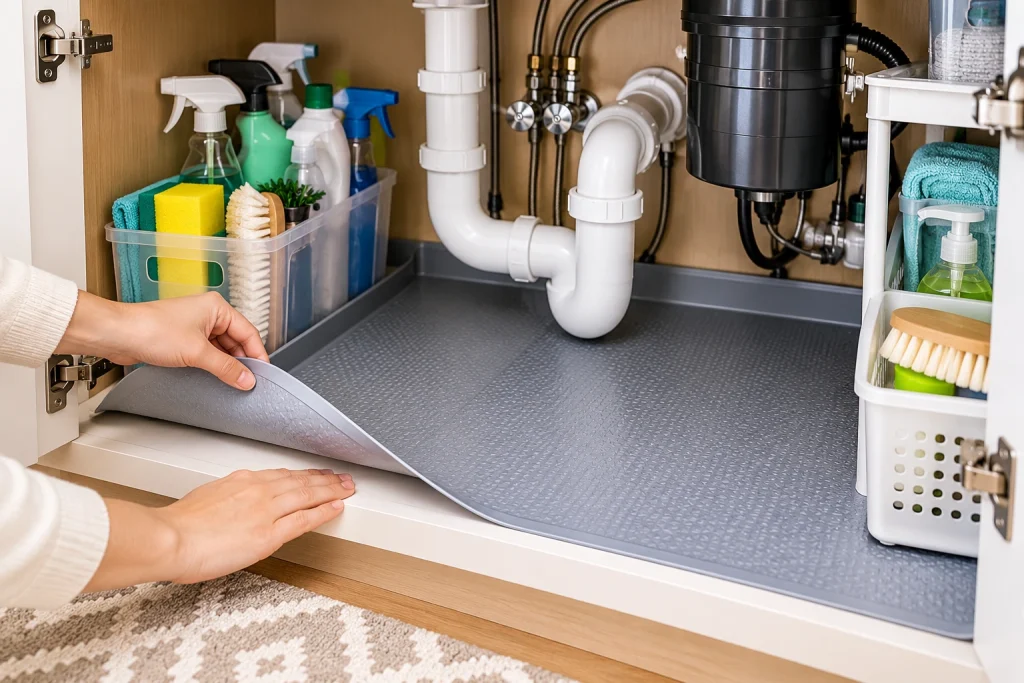
For example, see this waterproof silicone under-sink mat on Amazon.
A protective mat is especially useful if your cabinet has:
- Particleboard flooring
- Wood veneer
- Older plumbing
- Numerous pipe connections
The goal is not to assume a leak will happen.
It is simply easier to clean or replace a liner than repair a water-damaged cabinet.
5. Use an L-Shaped Organizer Around the Pipes
One of the smartest under kitchen sink organization ideas is an organizer that intentionally leaves space for plumbing.
Traditional two-tier shelves often run directly into the drain pipe.
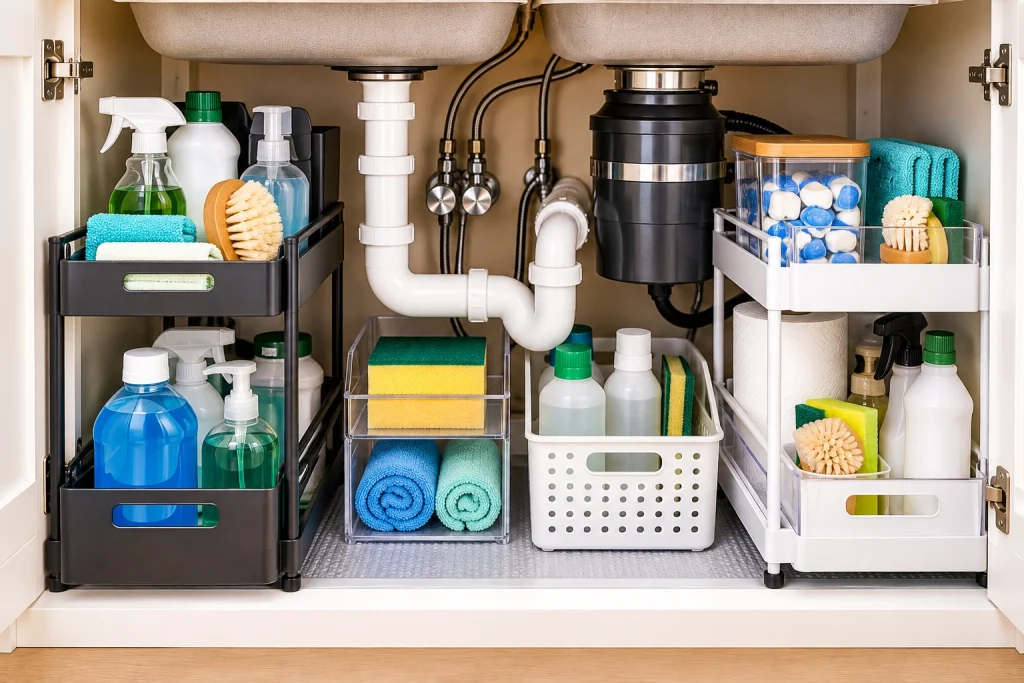
An L-shaped design places taller storage on one side while leaving an open area where plumbing can pass.
This is particularly helpful when the main drain pipe sits near the center of the cabinet.
See this L-shaped two-tier pull-out under-sink organizer on Amazon.
Use the lower level for heavier items such as:
- Cleaning bottles
- Dishwasher detergent
- Extra dish soap
Use the upper level for smaller items such as:
- Sponges
- Scrubbers
- Gloves
- Cleaning cloths
Keep the plumbing side relatively open.
You should still be able to see and reach the P-trap and shutoff valves.
6. Put Frequently Used Supplies on Pull-Out Storage
Deep cabinets create another problem: items disappear in the back.
Pull-out storage helps solve this because you bring the contents toward you instead of reaching behind bottles and pipes.
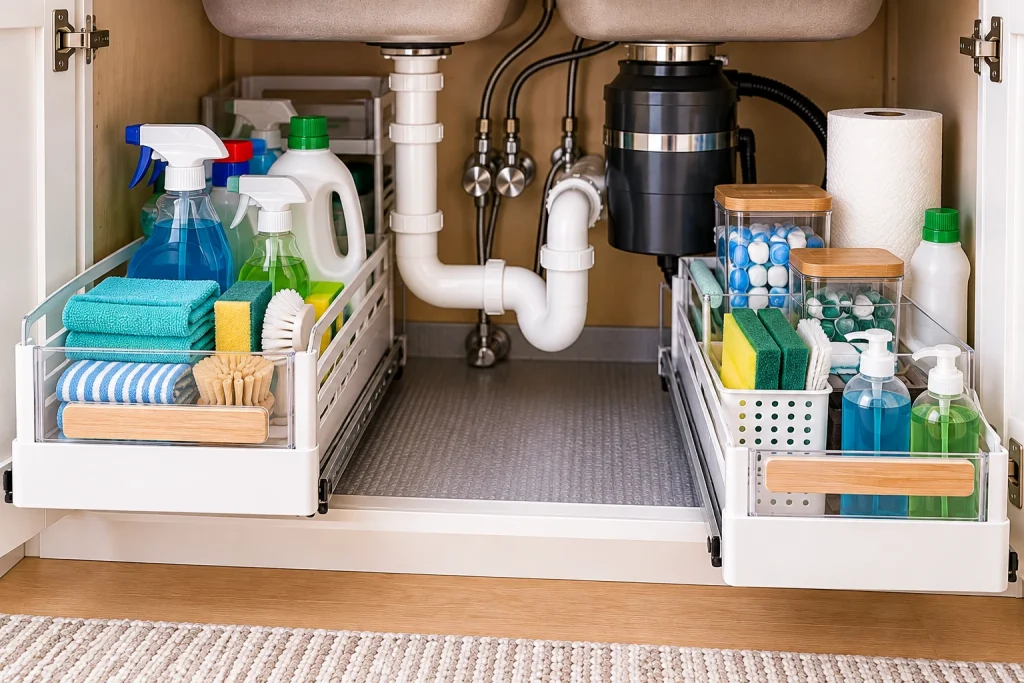
This works especially well for items you use several times a week.
Examples include:
- Dishwasher tablets
- Cleaning spray
- Dish soap
- Microfiber cloths
- Sponges
- Trash bags
If your plumbing leaves a straight, unobstructed section of cabinet on one side, a sliding organizer can make that area far more accessible.
See these expandable pull-out cabinet organizers on Amazon.
Before installing any sliding system, make sure it will not interfere with:
- Cabinet hinges
- Pipes
- Disposal
- Valves
- Door frame
Pull-out storage is useful only when it can move freely.
7. Use Two-Tier Storage for Small Supplies
Vertical space is often underused beneath the sink.
A two-tier organizer can double usable storage without requiring a wider cabinet.
This works especially well for smaller cleaning products.
Try grouping:
top tier: sponges + dishwasher tablets + gloves
bottom tier: sprays + bottles + refill products
A stackable or divided organizer is useful when you want smaller categories to stay separated.
See these two-tier under-sink organizers with movable dividers on Amazon.
The important part is not the number of shelves.
It is whether the organizer fits around your plumbing.
If the second tier blocks a pipe, choose a shorter unit or move it to the opposite side.
8. Create Zones Instead of Storing Items Randomly
One of the easiest under kitchen sink organization ideas is to divide the cabinet into simple storage zones.
Instead of placing products wherever they fit, assign each part of the cabinet a purpose.
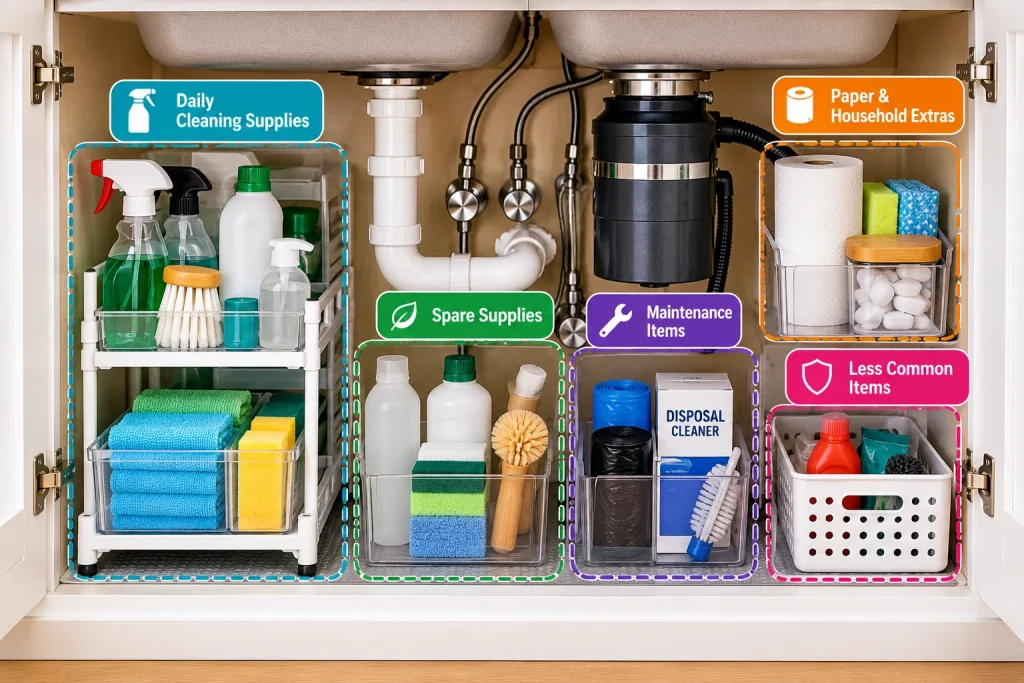
For example:
Everyday Cleaning Zone
Keep frequently used sprays and cloths near the front.
Dishwashing Zone
Store:
- Dishwasher tablets
- Dish soap
- Rinse aid
- Bottle brushes
together.
Backup Supply Zone
Keep unopened refills toward the back or on an upper tier.
Trash Zone
Store trash bags and recycling bags together.
Zones reduce the amount of searching required.
You know where each item belongs, which makes the cabinet easier to maintain.
9. Keep Tall Bottles Along the Sides
The center of the cabinet is usually where plumbing causes the most problems.
The sides often provide the tallest uninterrupted storage.
Use these areas for tall bottles such as:
- Cleaning sprays
- Dish soap refills
- Floor cleaner
- Dishwasher products
Shorter items can fit underneath or beside the plumbing.
Think of the cabinet as several irregular storage pockets instead of one big box.
That approach makes tight spaces much easier to use.
10. Keep the Area Directly Beneath the P-Trap Clear
It may be tempting to use every inch of cabinet floor, but leaving some empty space beneath the drain assembly is useful.
This gives you easier access if you ever need to:
- Tighten a connection
- Inspect for leaks
- Clean the P-trap
- Replace a fitting
It can also make small drips easier to notice.
Avoid piling bottles directly against plumbing joints.
You want to be able to inspect the pipes without unloading half the cabinet.
11. Do Not Block the Water Shutoff Valves
The shutoff valves are among the most important things inside the cabinet.
You should be able to reach them quickly.
Do not place:
- Fixed shelving
- Large bins
- Bulk packages
- Heavy bottles
directly in front of the valves.
In an emergency, you do not want to move several organizers before shutting off the water.
A good under-sink setup keeps important plumbing controls visible.
12. Work Around a Garbage Disposal Instead of Fighting It
A garbage disposal can take up a significant portion of the cabinet.
If yours occupies the center or one side, use the remaining space strategically.
A good arrangement might be:
one narrow organizer on the open side + small basket at the front + door storage
Avoid packing items tightly around the disposal.
Leave ventilation and access for maintenance.
Also avoid storing anything that could interfere with electrical connections or plumbing fittings.
The goal is organized storage—not maximum storage density.
13. Use the Cabinet Door for Lightweight Items
When floor space is limited, the cabinet door can provide extra storage.
Door-mounted storage works well for lightweight items such as:
- Gloves
- Cleaning cloths
- Small brushes
- Sponges
- Lightweight trash bags
Avoid putting very heavy bottles on the door.
Excess weight can strain cabinet hinges.
Also check that anything mounted to the door will not hit the sink basin, shelves, or plumbing when the door closes.
14. Store Cleaning Cloths Vertically
Cleaning cloths can quickly become a messy pile.
Instead of stacking them horizontally, fold or roll them and store them upright.
A small basket works well.
You can separate them by purpose:
- Kitchen surfaces
- Glass
- Stainless steel
- General cleaning
Vertical storage lets you remove one cloth without disturbing the rest.
It also makes it easier to see when you are running low.
15. Remove Unnecessary Product Packaging
Bulky packaging wastes valuable cabinet space.
For example, individually packaged dishwasher tablets may be stored inside a compact sealed container if their manufacturer’s safety directions allow it.
Trash bags can often be removed from oversized cardboard packaging and stored in a smaller container or dispenser.
The goal is to reduce visual clutter and make categories easier to identify.
However, keep original labels and safety information when needed.
Never move chemicals into food containers or unlabeled bottles.
16. Keep Similar Bottles Together
When every cleaner sits in a different part of the cabinet, the space feels more chaotic than it actually is.
Keep similar products together.
For example:
dishwashing: soap + tablets + rinse products
general cleaning: multipurpose spray + cloths
scrubbing: brushes + scrub pads + gloves
This creates a system rather than a collection of containers.
It also helps prevent buying duplicates because you can easily see what you already have.
17. Avoid Buying Too Many Organizers
Ironically, storage products themselves can create clutter.
Do not buy six bins before measuring the cabinet.
Start with the awkward parts:
- Plumbing
- Disposal
- Valves
Then determine what storage fits around them.
A simple setup might need only:
- One protective liner
- One two-tier organizer
- One narrow pull-out unit
- One small basket
More organizers do not automatically mean better organization.
The best system uses the fewest containers necessary to keep categories separated and accessible.
18. Use Clear Containers Only Where They Help
Clear containers can make supplies easy to identify, but they are not mandatory.
Opaque bins may create a calmer appearance.
Choose based on how you use the space.
Clear storage is useful for:
- Dishwasher tablets
- Sponges
- Small refill products
Opaque baskets can be useful for:
- Trash bags
- Cleaning cloths
- Gloves
The important part is visibility and accessibility—not matching containers.
19. Keep Backup Products Behind Everyday Products
Not everything needs prime cabinet space.
Items you use every day should stay near the front.
Backup products can sit behind them.
A simple depth system works well:
front: currently used products
back: unopened replacements
This keeps your daily routine easy without wasting deeper cabinet space.
20. Be Careful With Household Chemicals
Under-sink cabinets are commonly used for cleaning products, but safety matters.
Keep products:
- In their original containers
- Clearly labeled
- Upright
- Properly closed
For additional guidance on choosing and handling household cleaners, see the EPA’s Safer Choice program.
Do not mix cleaning chemicals.
If children or pets can access the cabinet, use an appropriate child-resistant cabinet lock and follow product storage instructions.
Some household products may be safer stored somewhere else depending on the manufacturer’s directions.
How to Organize a Very Small Kitchen Sink Cabinet
The most practical under kitchen sink organization ideas for very small cabinets focus on keeping only essential supplies under the sink.
For very tight spaces, prioritize only the supplies you actually use in the kitchen.
Try:
one narrow organizer + one small cleaning basket + trash bags
Move rarely used products elsewhere.
You can also take advantage of:
- Cabinet doors
- Narrow gaps beside plumbing
- Low areas underneath horizontal pipes
- Vertical space on the unobstructed side
The best under kitchen sink organization ideas for small kitchens focus on accessibility rather than storing everything in one place.
How to Organize Under the Kitchen Sink With Pipes in the Middle
A center drain pipe is one of the most common obstacles.
Instead of trying to place one large shelf across the entire cabinet, split the space into two zones.
For example:
left side: cleaning sprays and bottles
right side: dishwashing supplies
center: plumbing access
An L-shaped organizer can also work well because its open portion accommodates the pipe.
Use the space under horizontal plumbing only for short items that can be removed easily.
How to Organize Under the Kitchen Sink on a Budget
You do not need a complete set of matching containers. Many effective under kitchen sink organization ideas can be created with inexpensive baskets, trays, and organizers you may already own.
Start by using what you already have.
Possible low-cost storage includes:
- Small baskets
- Repurposed bins
- Plastic trays
- Existing drawer organizers
- Simple hooks
Spend money first on things that solve actual problems.
For many cabinets, the most useful investments are:
- A waterproof liner
- One organizer that fits around the plumbing
- One pull-out solution for deeper storage
Everything else is optional.
A Simple Under-Kitchen-Sink Organization Formula
If you want the easiest possible setup, use this formula:
Cabinet Floor
waterproof mat
Left Side
two-tier or L-shaped organizer
Right Side
tall cleaning bottles
Front
frequently used dishwashing supplies
Back
refill products
Cabinet Door
lightweight cloths, gloves, or bags
Center Plumbing Area
mostly clear
This gives everything a home without making maintenance difficult.
How Often Should You Reorganize Under the Kitchen Sink?
You should not need to completely reorganize the cabinet frequently.
Instead, do a quick check every few months.
Look for:
- Empty products
- Duplicate supplies
- Dampness
- Expired or damaged items
- Products that have moved out of their zones
Wipe the cabinet floor and organizer surfaces as needed.
A system that constantly needs rearranging is probably too complicated.
Simple systems tend to last longer.
Common Under-Sink Organization Mistakes
Blocking the Plumbing
Always keep access to pipes and valves.
Buying Organizers Before Measuring
Cabinet dimensions alone are not enough; measure around the plumbing too.
Storing Too Much
The cabinet becomes easier to use when unnecessary supplies are removed.
Using Deep Bins for Everything
Deep bins can hide smaller products.
Ignoring Leak Protection
A small amount of water can damage cabinet materials over time.
Making the System Too Complicated
If every item requires three steps to put away, the organization probably will not last.
Frequently Asked Questions About Under Kitchen Sink Organization
What is the best way to organize under the kitchen sink?
The best way to organize under the kitchen sink is to work around the plumbing, protect the cabinet floor, use vertical storage on unobstructed sides, and group supplies into simple categories.
Keep the drain pipes and shutoff valves accessible.
How do you organize under the kitchen sink when pipes are in the way?
Measure the usable areas on each side of the pipes and choose organizers that fit those spaces. L-shaped shelving, narrow pull-out units, and small baskets can use awkward areas without blocking plumbing.
What should I store under the kitchen sink?
Common items include dish soap, dishwasher products, cleaning sprays, sponges, brushes, gloves, cloths, and trash bags.
Only store products there when their labels and safety instructions allow it.
What should not be stored under the kitchen sink?
Avoid storing food, items that can be damaged by moisture, or anything that prevents access to plumbing and shutoff valves.
Household chemicals should always be stored according to their labels and kept safely away from children and pets.
Should I put a liner under my kitchen sink?
A removable waterproof liner can help protect the cabinet base from small drips and spills and can make cleanup easier.
It does not replace regular leak inspections.
Are pull-out organizers good for under the kitchen sink?
Yes, when the plumbing layout provides enough uninterrupted space for the organizer to slide.
Measure carefully before purchasing one.
How can I make a small under-sink cabinet hold more?
Use vertical organizers, cabinet-door storage for lightweight supplies, narrow bins, and the open areas beside plumbing.
Removing rarely used products is often more effective than adding more storage.
How do I keep under-sink storage from becoming messy again?
Give every category a defined zone, keep daily products near the front, store backups behind them, and remove empty containers regularly.
A simple system is easier to maintain than a complicated one.
Final Thoughts
The best under kitchen sink organization ideas do not try to eliminate the awkward plumbing or pack every inch with storage.
They work with the cabinet you actually have.
Start by emptying the space and checking for leaks.
Measure around the pipes.
Protect the cabinet floor.
Use L-shaped, vertical, or pull-out storage where the plumbing allows it.
Group similar supplies together.
And most importantly, keep the drain assembly and shutoff valves easy to reach.
Once you stop treating the area under the sink like a normal rectangular cabinet, kitchen under sink organization becomes much easier.
A few carefully chosen organizers and a clear system can turn an awkward, cluttered cabinet into storage that is practical, accessible, and easy to maintain.